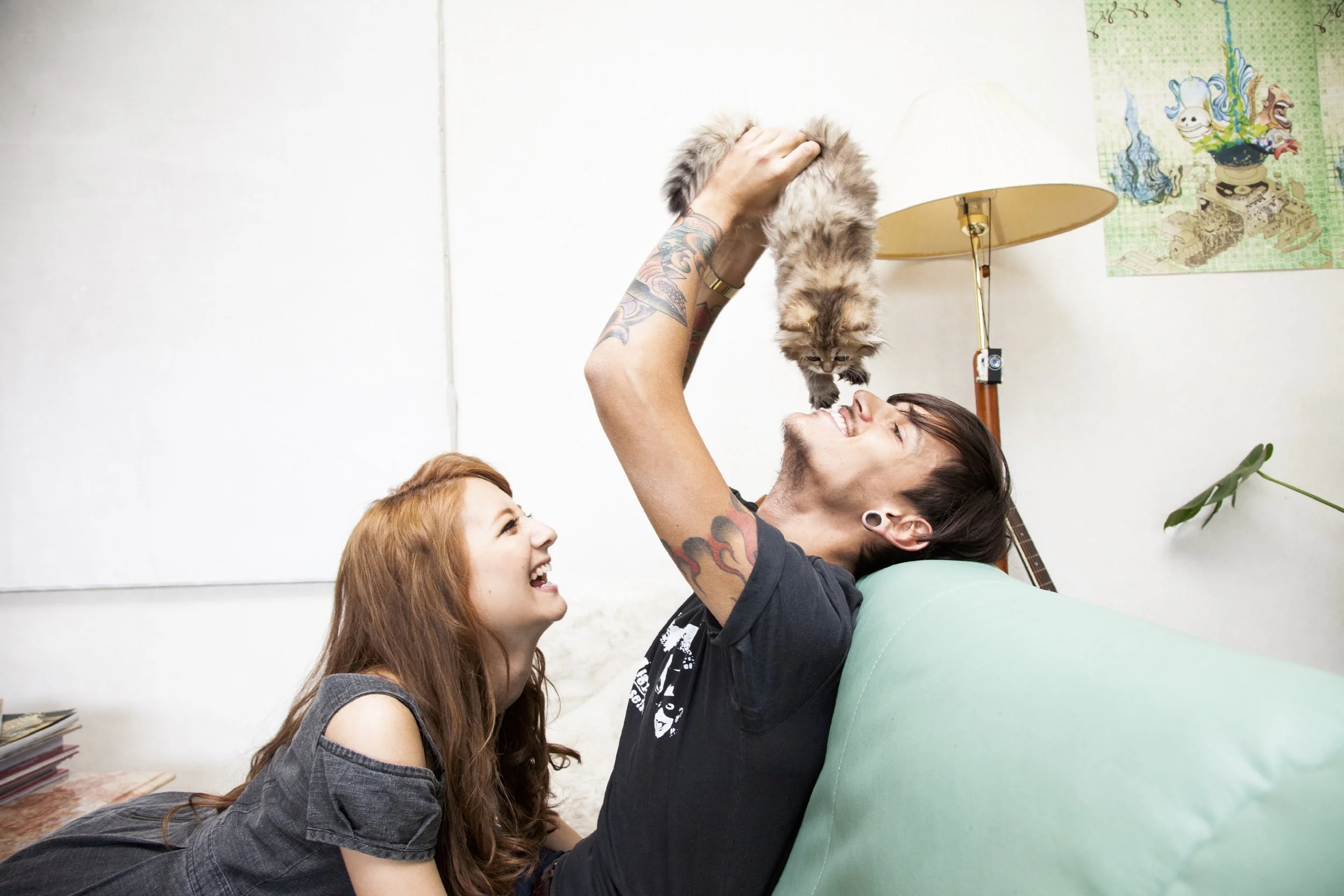
The Selby's Guide to Photographing
Your Cat or Dog
Indoor Pet Photography Guide
ISO Settings
Dark interiors: ISO 6400 or 3200
Normal interiors: ISO 1600
Shutter Speed
Chill dog: 1/250s
Active dog or all cats: 1/500s
F-Stop (Aperture)
F2: Focus on your pet's face. Blurs the messy living room behind them. SHALLOW
F4: Pet plus a very close human. MEDIUM
F8: Pet in their whole environment, human, bed, bowls, chaos and all. DEEP FOCUS
Focus
Some cameras have a pet or animal focus setting. Check it out.
Focus on the eyes. The eyes are key for sharpness.
Cropped shot without a face: Focus on the details (paws, a curled tail, cute nose).
Adjustments After Test Photo
Too dark? Increase ISO (but beware it gets grainy higher than ISO 6400)
Too bright? Decrease ISO
Indoor Shooting Tips
Turn off overhead lights, use natural light: Softer, more realistic fur tones. Skip the flash.
Shoot toward light sources (like windows): Backlighting makes fur glow at the edges.
Get down on their level: Shoot from pet-eye height, not human height. Lie on the floor.
Cats find the light for you: Wherever the sun puddle is, that's your set.
Outdoor Pet Photography Guide
ISO Settings
Outdoor shade: ISO 400
Direct sunlight: ISO 100
Shutter Speed
Calm dog on a leash: 1/250s
Running, fetching, leaping: 1/1000s
F-Stop (Aperture)
F2.8: One pet, blurred park behind them. SHALLOW
F4: Pet and their close-by human. MEDIUM
F8: Pet and their farther-away human. DEEP FOCUS
Focus
Some cameras have a pet or animal focus setting. Check it out.
Focus on the eyes. For a running dog, use continuous autofocus and burst mode. Take fifty. Keep one.
Adjustments After Test Photo
Too dark? Increase ISO slightly to ISO 800
Too bright? Change shutter speed to 1/500, 1/1000, 1/2000, 1/5000 (to let in less light)
Outdoor Shooting Tips
Place your pet in shade or use a diffuser: Harsh sun means harsh shadows.
Shoot toward the sun for backlighting: Glowing fur.
Bring treats and a squeaky toy: Hold them just above the lens for eye contact. One squeak gets the head tilt. Don't overuse it.
Tips from Friends and Family
Selby's Dad Tip Don't have stuff (like lampposts) growing out of your pet's head. Pay attention to backgrounds.
Young Thug's Tip "Everybody got tigers, so I wanna go get a liger." Everybody's got the sit-and-stay portrait. Go get the weird one. Shoot from the ground up the nose. Shoot just the whiskers. Be the liger.
The Selby's Tip It's not about the gear, it's about the vision. Just kidding! It's about the treats. Your pet gets a commission on every shoot.
Rule of Thirds Tip Split the frame into thirds. Put the eyes on one of the lines. Leave space in front of the nose so your pet has somewhere to look, or somewhere to bolt.
Bonus Tips
Light and Contrast
Add darkness, not light. Hang a dark blanket on one side of your pet to deepen shadows on that side of their face. Instant shape, zero gear.
Window light is a look. Kill every other light source and let a single window carve the fur.
Flip it for drama: light the far side of the face and let the near side fall dark. Moody cat and dog. Shoot from the shadow side.
Overcast day? Don't fight it. Flat light is soft light. Lean into gentle, even portraits and add contrast with a dark background instead.
Watch where light bounces up from. Pale floors and sand fill in shadows from below and flatten the face. A black towel under a food-bowl shot restores contrast.
Golden hour is pet hour. Low sun plus fur equals rim light you can't fake.
Composition and Framing
7. Shoot through things: doorways, cat tree holes, between chair legs. A frame inside the frame. 8. Go extremely low. Not crouching. Camera on the floor, screen tilted up. The world from ant height makes a chihuahua monumental. 9. Go extremely high. Straight-down shot of a curled sleeping cat. It becomes a shape, almost abstract. 10. Cut the frame in half with a hard line, window edge or wall corner, and put the pet on one side of it. 11. Shoot the details as a series: just paws, just the nose, just the tail curl, just one ear. Hang them as a grid.
Moment and Behavior
12. Photograph the routine, not the pose. Waiting at the door, the pre-nap circle, the 5pm dinner stare. That's the real portrait. 13. The moment after the moment. Ball caught, shake finished, that half-second exhale. Keep shooting past the obvious peak. 14. Include the human, cropped. Just a hand on the head, legs the cat weaves through. 15. Let them come to the lens. Set the camera down at their level and wait. The curious close-up nose shot beats a chased one.
Environment and Story
16. Shoot their stuff without them: the destroyed toy, the dented bed, the scratched couch corner. 17. Same spot, every season. One chair, one pet, twelve months. That's a photo project. 18. Weather is a character. Wet-dog rain shots, snow on whiskers.
Shooting with Your Phone
19. Use burst mode like it's free, because it is. Hold the shutter through the whole jump. 20. Portrait mode fakes fur edges badly. For fluffy pets, shoot normal mode and let real distance blur the background. 21. Shoot 0.5x ultrawide an inch from a dog's nose. Big snout, tiny body. 22. Flip the phone upside down so the lens sits at floor level.
Getting Their Attention
23. Retire each sound after two uses per session. Rotate: kissy noise, tongue click, fake sneeze.